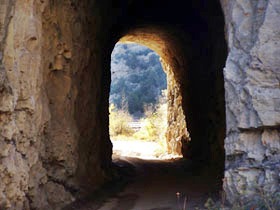
Meadow Gulch Divide
(aka Emigrant Pass, Salina Canyon)
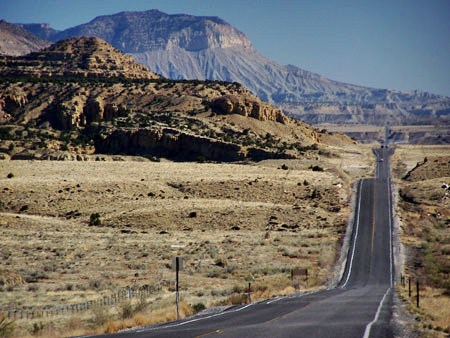
After cycling the San Rafael Swell summit(u), one could
come to the conclusion, that cycling the shoulder of I70
is not such a bad thing after all. The Meadow Gulch Divide
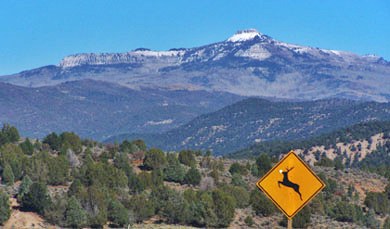
is the next summit to the west. This higher summit is
nevertheless the lowest Wasatch Plateau crossing south of Soldier
Summit. Neither does it have the scenic drama of its
I70 neighbor. Instead the Meadow Gulch Divide is the
missing link of a long paved circle dayride over four
paved summits. The de Lorme Utah Gazeteer Map labels this
pass as Meadow Gulch Divide. The Fishlake National Forest
map calls it Emigrant Pass, and historical literature
usually refers to it as Salina Canyon.

click on profile for more detail
|
|
1.(5160ft,mile00) START-END WEST:
Salina
2.(5290ft,mile02) Salina I70 interchange
3.(5750ft,mile08) dirt road up Gooseberry Valley
joins on right
4.(6780ft,mile19) junction with road to coal miles
on left
5.(7910ft,mile28) TOP
6.(6520ft,mile36) START-END EAST: Fremont Junction
interchange
7.(5690ft,mile45) START-END ALTERNATE: BLM land
interchange
|
Approaches
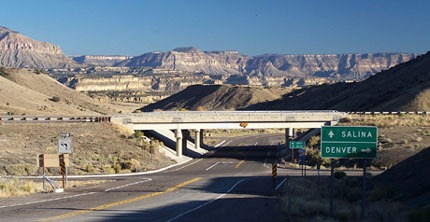
From West. A selection of fast food joints, gas
stations and businesses catering to truck drivers mark the I70
entrance west of Salina, where cyclists can join the four
lanes of traffic to start the long gradual climb to the
summit. A rumble strip separating the shoulder from traffic
actually helps in making the ride safer. There is still plenty
of room to the right of it. A dirt road parallels almost all
of the route. But switching between the two at will is
extremely difficult, because of a very well constructed fence
and an occasional stream separating the two routes.
From
South. The profile starts on I70 one exit east of Fremont
Junction. The most interesting part may actually be the bottom
of the southern approach. I70 begins to extricate
itself from the San Rafael Swell scenery. Rock layers conspire
to tilt in such a way that the climb is steeper than it looks
from the saddle. Fremont Junction, although prominently
marked on every Utah map, is just what it says, a junction.
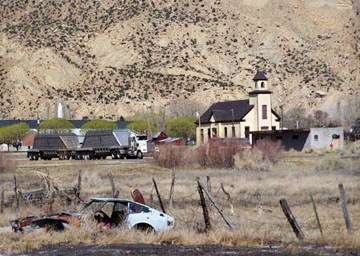
The picture above shows "Central Fremont Junction".
Here this profile joins with the Hogan
Pass profile. The spot also marks the end of the San
Rafael Swell to the east, and the beginning of a canyon into
the wetter Wasatch Plateau to the east.

The alluvial fans originating from the mouth
of the canyon canyon at Fremont Junction give a special
vantage point on the plateau escarpment, along which
Spaniards, Gunnison and other explorers made their way to
enter this easy passage. During the early history of the
crossing, the mouth of the canyon was reached not by the route
shown in the profile, but from the north following the Wasatch
escarmpent.. Even though it's not shown in the profile this
route is shown in the picture above, and further
discussed in the history section.
The
road following the Wasatch escarpment from the north would be
the perfect cycling route if it were not for one small detail,
the "scurge of Utah". Double trailer coal trucks use
expensive hydrocarbons (gasoline) to carry cheap hydrocarbons
(coal). They make up regular road trains between the various
coal mines and powerplants in the area. There is no shoulder
on the northern part of Ut10 (April/06) and while most coal
train drivers are safe and considerate, some are not. The
problem is that there seems to be no uniform code of behaviour.
Let's face it, cyclists are pretty rare around here. The
picture to the right shows one of those monsters cruising
through the town of Emery. But the situation improves quickly
heading north. Beginning in Moore, a wide shoulder and
alternative parallel routes are available.
History
Spanish Trail. Early travelers coming
from the east went out of their way to go around the San
Rafael Swell, only to head back south and take advantage of
this easy crossing of the Wasatch Plateau. After Escalante and
Domiquez' adventurous but unsucessful effort to forge a route
between Santa Fe and spanish California, a route connecting
the two pearls of the empire did emerge after all. It differed
in substantial details from the Escalante Dominquez route.
While the spanish padres crossed north near Soldier
Summit, the primary route of the network of trails called
the spanish trail, skirted the San Rafael Swell by way of
Cottonwood Creek and Ferron Creek. From the current town of
Ferron the route paralleled the mighty escarpment of the
Wasatch Plateau, probably slightly east of today's Ut10 and
then crossed the Meadow Gulch Divide. Until 1848 caravans of
traders transported goods derived from a surplus of sheep west
to California. In the other direction horses were an important
commodity. The Spaniards also picked up Indian slaves along
the route.
Gunnison Rail Survey(<Blue
Mesa Summit(co)|). We last encountered Captain Gunnison
having substantial trouble visualizing his transcontinental
railroad through the Black Canyon of the Gunnison in Colorado.
The survey continued anyway. After many miles of flat going to
today's town of Green River, he gave a wide birth to the next
obstacle, the San Rafael Swell. He detoured north as far as
the current area of Price. Heading south along the Wasatch
Front through the entire length of Castle Valley he also
crossed the Meadow Gulch Divide to emerge from Salina Canyon
on the Sevier River. The survey took a tragic end when he was
killed by Paiute Indians.
In
1882, DRG and DRGW railroads officials were in a discussion on
exactly where to continue their rails that connected Denver to
Green River so far. A route around the northern end of the San
Rafael Swell and Salina Canyon was surveyed for tracks that
might eventually lead to Los Angeles, should it ever come to
that. Embankments over the San Rafael Swell and tunnels in
Salina Canyon were even built. But in the end, the option to
head north over Soldier
Summit to Provo for a more direct connection to Salt Lake
City, proved economically irresistible and the Salina Canyon
route was forgotten.
Tours
dayrides: (paved): A long dayride circle over Hogan
Pass, the Ut24 summit:
Loa-jctUt62, another Ut24
summit: Sigurd-jctUt62, returning over the Meadow Gulch
Divide measured somewhere over 116 miles and 7500ft of
elevation gain in over 10 hours. Unfortunately the computer
magnet shook loose on a rumble strip, while crossing this last
divide with dynamo driven headlights sometime between 8.30 and
10.30pm. (m2.6.4.18)
(paved+unpaved)
A loop ride beginning in Fremont Junction, crossing this
summit, then returning via FR010
shoulder summit: Convultion Mine, Convultion Canyon and
Ut10 to the starting point measured 47 miles with 3600ft of
climbing in 5 hours (m3:06.10.06).
(paved+unpaved) Another loop ride starging in Fremont
Junction, crossing Hogan Pass,
the Niotche - Lost
Creek Divide, and last Meadow Gulch Divide to get back to
the starting point measured 98 miles with 8500ft of climbing
in 8:1 hours. This is a kind of MTB version of the first ride
in this list.
|