Bookcliffs Divide 

Wilderness in eastern Utah seems to come in two categories. One category is labeled as such. People who recognize its beauty fight to regulate its usage and designate it as federal wilderness area, park or monument. Motorists on dirt roads often drive Honda Civics or Subarus and wave at cyclists as they pass. Roads at lower altitudes tend to have sandy stretches.

The other category of Utah wilderness is frequented by people who recognize its economic value. They have a propensity for drilling wells and driving ATVs. Motorists often drive Dodge RAM trucks with at least one ATV on the back. They often pass cyclists at full speed leaving them in a thick cloud of dust. Roads at lower altitudes tend to have sandy stretches. But all generalizations are false, including this one, which I think would make the preceding statements true again.

While the area north of I70 and Rabbit Valley, including the Kokopelli Trail, belongs into the first category, a large part of the Book Cliffs area, north of I70 belongs, to the second. And still - what a fascinating area it is to cycle.

The Bookcliffs Divide is a marked divide along the Book Cliffs Ridge road. The route described here follows a large part of that ridge road, so that the divide itself is not a point of highest altitude.


01.(mile00,5000ft) START-END SOUTH WEST junction of Book Cliff Ridge road with an unlabeled dirt road, south of Book Cliffs.
02.(mile04,5170ft) route to Hay Canyon stays left. Stay left.
03.(mile11,5880ft) stay left at fork
04.(mile14,6190ft) stay right at fork
05.(mile17,6770ft) stay left at fork
06.(mile18,7800ft) ridge road continues to right along rim at this major intersection
07.(mile28,8340ft) Bookcliff Divide; junction with road to Ouray on left. Route continues along ridge road to right
08.(mile35,8450ft) TOP: high point
09.(mile35,8250ft) route continues to right down East Canyon
10.(mile51,5179ft) same as point 2
11.(mile54,5000ft) START-END SOUTH-EAST: same as point 1

Approaches

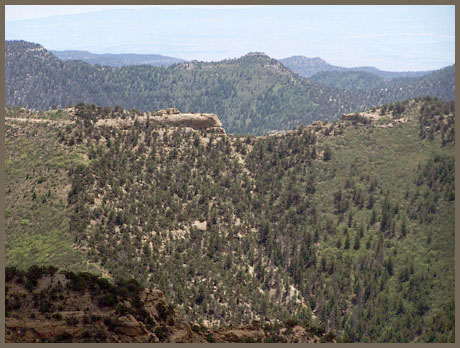
From South West. The point where the profile begins can be approached from I70, by taking the Westwater Exit and then roughly paralleling the interstate east. Then turn north onto a paved road at the Haley gas processing facility. Pavement ends just at the point where the profile begins. The two approaches described here, Hay Canyon and East Canyon, divert at a picturesquely isolated farm. The junction  is signed. The climb up Hay Canyon begins as straight forward, shallow climb. The scenery of the staircase like rock layers, flanking the canyon, changes little as you make your way up. No predominant caprock forms large cliffs as is so often the case in Utah. The staircase has more or less equal steps, making it less dramatic. At the same time this uniformity emphasizes the vastness of the Book Cliffs area with its overwhelming maze of canyons. Each one is just a little bit different. An altimeter can serve as the only verification that we are gaining altitude. A great number of junctions to well heads exist along the route. Taking the route most traveled worked in my case, and led me to the top. Approaching the plateau, the grade and sand suddenly pick up dramatically, in order to deliver the rider to a well signed junction, designating routes to Moon Ridge, Seep Ridge and others. The route along the Book Cliffs Ridge road is not labeled as such on these signs. It is labeled in the de Lorme Gazeteer. The route continues to the right, following the rim intermittently. The road delivers views of forested canyon ridges to the south and the a plain to the north, all seen between innumerable gas well heads. After an initial high point the Book Cliffs Divide is reached just past the junction with a signed dirt road north to Ouray (Utah). The divide is labeled with a sign. The point of highest altitude comes several bumps later near a transmission tower. The ridge road contains countless small ups and downs, which don't show up well in the profile, but do manage to make an impression on the legs.


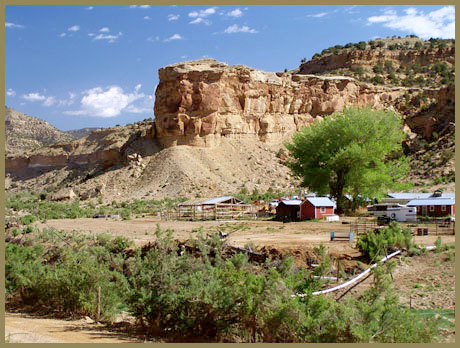
From North West. The route through East Canyon is described in a downward direction. Prior to this descent, innumerable turnoffs to the south lead to dead end well heads. The turnoff down the rim is very obvious, which is the major positive attribute of this route. After a small downhill on the ridge road the right fork down East Canyon continues steeply downhill. The left fork on the ridge road climbs towards a transmission tower in plain sight, immediately ahead. This is the second transmission tower along the route. The canyon is quite sandy near the top, making it probably inevitable to get off the bike at least a few times. But it is not nearly as sandy as the Kokopelli Trail approaching the Dewey Bridge area from the north, on the other side of I70. After an initial steep descent the canyon gives the impression of ending early. But it is still quite a ride to the junction at that lonesome farm house, which is the only building structure along the entire route (first picture).


Tours

Dayrides. (m3:6.5.20) A ride beginning about 5 miles downvalley from the south western end of the profile, climbing Hay Canyon, crossing the Book Cliffs Divide and the Book Cliffs Ridge road summit(u), then descending through East Canyon measured 65.5 miles with 5770 feet of climbing in 6:3 hours.


Copyright (C) 2003-2008 by Michael Fiebach - All Rights Reserved